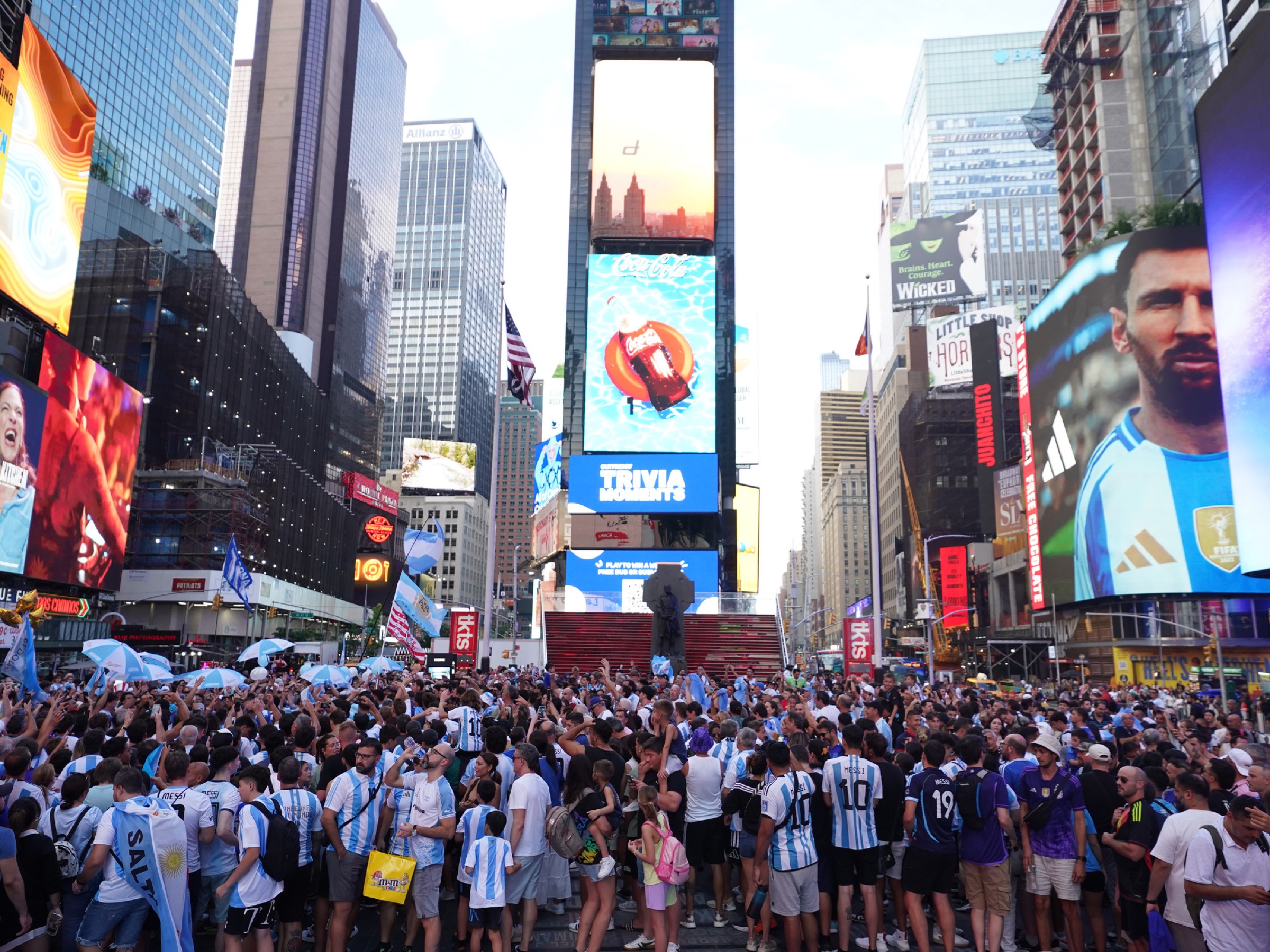
The tournament hosted by Canada, the United States, and Mexico showcased the capacity to coordinate a mega-event across the continent. It also revealed an incomplete integration: capital flows more freely than many Latin American visitors, workers, and small suppliers.
By Leo Ludueña Illanes · Birdi Finance · July 2026
For several weeks, the World Cup transformed North America into a single map. Matches, sponsors, broadcasts, and marketing campaigns traversed Canada, the United States, and Mexico as if the borders were merely production lines for the same spectacle. It was the first tournament with 48 teams, 104 matches, and three host countries: a demonstration of scale that demanded coordination among 16 cities, airports, transportation networks, payment systems, and security services.
However, the image of an integrated continent lasted until someone tried to follow their national team from one country to another. Then visas, electronic authorizations, immigration controls, customs regulations, and connection costs reappeared. The ball was played under a global brand; the fans, workers, and small businesses operated under three different national regimes.
This contradiction is the true economic legacy of the World Cup. Not because a soccer tournament should abolish borders, but because it offered an exceptional opportunity to test temporary mechanisms for mobility and trade facilitation that could later become permanent policies. The region had before it an integration laboratory. To a large extent, it used it to manage a multitude, not to design a more connected market.
Three hosts do not equal an integrated region
The trilateral organization relied on a foundation that does not exist with the same depth in the rest of Latin America. Since 2020, Canada, the United States, and Mexico have shared the USMCA, the successor to NAFTA, which regulates one of the densest production relationships in the world. Cars, food, digital services, and components cross their borders every day. Even so, the trade agreement did not create a free movement zone comparable to the European Schengen Area.
There was no general “FIFA visa” to attend matches in Canada: each visitor remained subject to a visa or electronic authorization based on their nationality. The United States maintained its own admission system, and Mexico its own. A stadium ticket was never considered an entry permit. Therefore, the sports coordination coexisted with a fragmented experience for those who wanted to visit the venues.
The problem isn't just tourism-related. A mega-event mobilizes journalists, technicians, production staff, food service providers, transportation companies, artists, software developers, and entrepreneurs. Large corporations can absorb legal teams, permits, and administrative costs. For a Latin American SME, each additional form, certification, or delay can be the difference between participating in the value chain or watching the business from the sidelines.
Mexico was host and, at the same time, a border
Mexico occupied a unique position: it was the Latin American component of the tournament and, simultaneously, the bridge to the bloc's two largest markets. This dual role could have transformed the country into the entry point for suppliers, creative talent, and technological solutions from across the region. But productive integration doesn't arise from sharing a language or playing matches on the same schedule.
The opportunity required a clear agenda: expedited customs windows for accredited suppliers; temporary recognition of certain professional certifications; logistics corridors for equipment; financial instruments for SMEs; interoperability of payments and invoicing; and a regional procurement program that would connect organizers and large contractors with Latin American companies. Without these bridges, the economic benefits tend to concentrate in firms already integrated into North American supply chains.
This isn't to say that none of it happened. There was business, employment, tourism, and exposure for Mexican and Latin American companies. The relevant question is different: how much of that activity left replicable capabilities for regional trade once the screens went dark? If the special procedures end with the event and connections depend on exceptional private relationships, the legacy is short-term revenue, not integration.
The Latin American divide doesn't start at the airport
The World Cup made visible obstacles that already weigh on everyday trade. Latin America has numerous subregional agreements, but its infrastructure and procedures are still largely organized to connect each economy with extra-regional markets rather than with its own neighbors. The IDB estimated in 2026 that intraregional trade in South America represents only between 12% and 15% of exports, while logistics costs consume between 18% and 35% of the final value of goods.
It's an integration process fraught with treaties and far too many frictions. Forms, health regulations, tax systems, and transportation requirements all change. Border crossings add uncertainty, and physical corridors often end where the neighboring jurisdiction begins. In this context, a small or medium-sized enterprise (SME) needs more than just tariff reductions; it needs predictability regarding shipment delays, which documents will be recognized, and how it will collect payment without losing margin on conversion or intermediation.
That's why integration can't be measured solely by the volume of capital mobilized during the tournament. It must also be measured by the number of players capable of participating. If effective access remains limited to large sponsors, global operators, and travelers with pre-existing documentation, the market can grow without becoming more inclusive.
What can still be salvaged
Calling the World Cup a missed opportunity shouldn't serve as its epitaph. A mega-event yields data rarely seen under normal circumstances: crossing times, peak demand, interoperability failures, fraud patterns, airport bottlenecks, and supplier performance. Transforming this evidence into public policy is still possible.
The first task is to publish comparable evaluations of cross-border operations: which procedures were simplified, who could benefit from them, how much time and money was saved, and which should remain. The second is to adapt the solutions to existing Latin American frameworks, from the Pacific Alliance and Mercosur to the Mesoamerican corridors, without assuming that a single model will work for different realities. The third is to design the next experience from the perspective of SMEs and individuals, not just from that of federations, states, and large contractors.
There are concrete and gradual measures: interoperable customs documents; verifiable digital identity; connected one-stop shops; mutual recognition of signatures and certificates; coordinated immigration information; and more transparent regional payments. and temporary, limited, and auditable permits for event-related activities. None of these require open, uncontrolled borders. They require borders capable of discerning risk without turning all legitimate movement into an obstacle course.
The Test Football Left Unfinished
The World Cup demonstrated that three governments, distant cities, and companies from multiple sectors can coordinate when there is a fixed date, clear incentives, and public attention. This capacity is significant. But it also revealed a hierarchy: the global commercial infrastructure was ready to sell a continental experience; the institutional architecture was not as prepared to make that experience truly cross-border.
Latin America does not need to copy North American integration or turn football into foreign policy. It needs to learn from the gap between the tournament map and the real map of mobility. The missed opportunity was believing that sharing venues equated to sharing an economic space. The remaining opportunity is to use what has been learned so that the next major event is not an island of efficiency surrounded by the same old barriers.
When capital, data, and transmissions cross borders in seconds, but an individual or a small business needs weeks to find out if they can do the same, integration remains incomplete. The World Cup of the tri-border areas didn't resolve this tension. At least it made it impossible to ignore.
Sources
• FIFA — 2026 World Cup format, venues, and schedule
• Government of Canada — 2026 World Cup entry requirements
• U.S. Trade Representative — Treaty between Mexico, the United States and Canada (T-MEC/USMCA)
• IDB — South Connection and South American logistics integration